

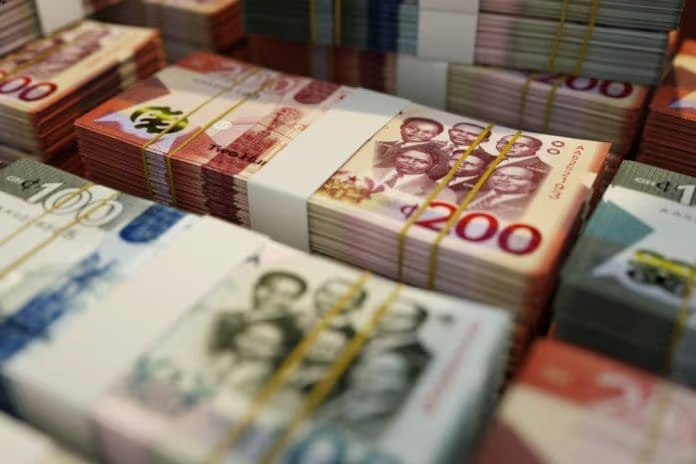
Fresh data from the Bank of Ghana’s latest Economic and Financial Data for January 2026 shows the Ghana cedi has come under renewed pressure, losing ground against major global currencies at the start of the year.
On the interbank market, the cedi traded at GH¢10.88 to the US dollar in January 2026, compared with GH¢10.45 at the end of December 2025 — a depreciation of about 4 per cent.

The local currency also weakened against other major currencies, losing 4.9 per cent to the British pound (closing at GH¢14.77) and 4.1 per cent to the euro (closing at GH¢12.80).
Across segments of the foreign exchange market, performance was mixed over the past two weeks. In the retail market, the dollar traded within a narrow band, moving from GH¢11.90 to GH¢12.15, while the pound and euro strengthened, closing at around GH¢16.30 and GH¢14.20 respectively.
Analysts attribute the January depreciation to a combination of seasonal foreign exchange demand, portfolio adjustments typical at the start of the year, and the cedi’s underlying sensitivity to global financial conditions.
However, the scale of the decline remains modest compared to the exceptional gains recorded in 2025. After depreciating by 3.9 per cent in January 2025 and extending losses through February and March, the cedi reversed course dramatically in April. By May 2025, it had appreciated by about 43 per cent against the dollar since the start of the year, supported by improved investor confidence, stronger foreign exchange inflows, and tighter policy coordination. The rally was sustained through the rest of the year, with the cedi closing 2025 with a year-to-date gain of 40.7 per cent.
Beyond exchange rate movements, the Bank of Ghana’s data also point to improving debt dynamics. Ghana’s public debt trajectory showed further signs of stabilisation in November 2025. Total public debt stood at GH¢644.6 billion (equivalent to 45.5 per cent of GDP), declining by about GH¢40 billion between September and November 2025, reflecting reduced borrowing and improved cash management.
In dollar terms, public debt eased to US$57.2 billion in November, with external debt moderating to US$29.3 billion (or 23.3 per cent of GDP). Fluctuations were largely driven by valuation effects rather than fresh borrowing.
The early-year weakness of the cedi contrasts sharply with the strong performance in 2025, but analysts remain cautiously optimistic, noting that the macroeconomic environment has improved significantly and could provide a foundation for renewed stability in the coming months.


